

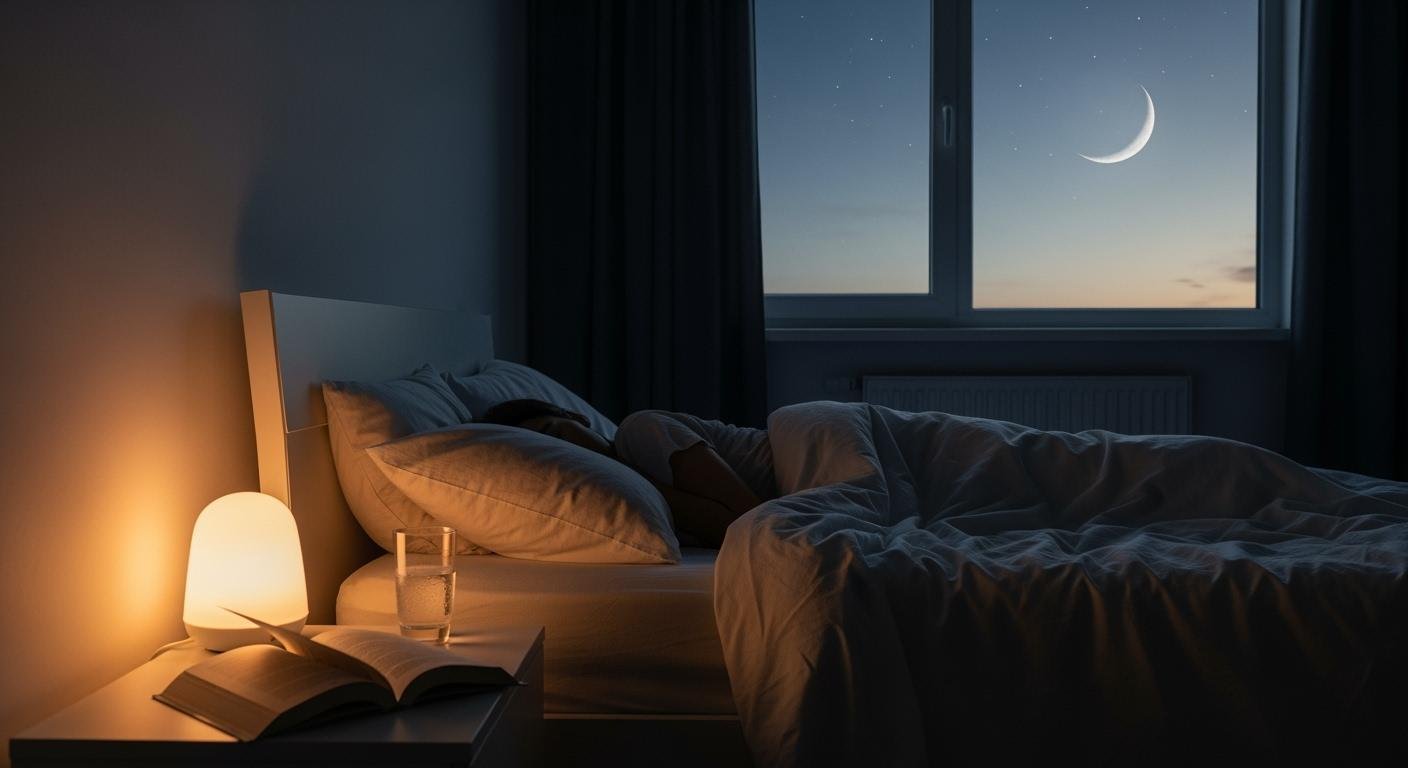
Does the frustration of insomnia feel familiar? You are not alone. Up to 35 percent of adults have trouble falling asleep. This guide offers help for falling asleep faster. You can use these simple tips tonight to help you fall asleep faster.
Here is your roadmap to a better night’s rest:
- Optimize Your Sleep Environment
- Create a “Power-Down” Routine
- Use Breathing Techniques
- Watch Your Evening Diet
- Know When to Get Out of Bed
- Calm Your Racing Mind
- Use Light to Your Advantage
Tip 1: Optimize Your Sleep Environment

Your bedroom should be a sanctuary for rest. You can transform your room into the perfect sleep haven with a few simple tweaks. Think of it as creating a cave: dark, cool, and quiet. This environment sends powerful signals to your brain that it’s time to shut down and get some quality sleep. 😴
Make Your Room Dark
Light is the most powerful signal for your brain to stay awake. Evening exposure to light, especially blue light from screens and bulbs, can disrupt your body’s internal clock. This makes it harder to fall asleep. Your brain needs darkness to produce melatonin, the hormone that makes you feel sleepy.
You can easily create a dark space.
- Blackout curtains are a great investment to block streetlights and early morning sun.
- A simple sleep mask can also provide total darkness, no matter where you are.
Keep Your Bedroom Cool
Have you ever noticed it’s harder to sleep in a hot, stuffy room? There’s a scientific reason for that. Your body’s core temperature naturally drops to initiate sleep. A cool room helps this process along.
Studies show the ideal temperature for sleep is between 60-67°F (15-19°C). Setting your thermostat in this range tells your body it’s time to rest.
- Optimal Range: 60°F to 67°F (15°C to 19°C)
- Acceptable Range: 68°F to 77°F (20°C to 25°C)
Ensure It’s Quiet
Sudden noises can easily pull you out of light sleep. A quiet environment is crucial for falling and staying asleep. If you live in a noisy area, you have options to create peace. Earplugs are a simple and effective solution. A white noise machine can also mask disruptive sounds like traffic or a neighbor’s TV.
Pro Tip: Using a White Noise Machine If you use a white noise machine, keep the volume low—no louder than a quiet conversation. The goal is to block sudden noises, not to create a loud environment. See the recommended levels below.
| Organization | Recommended Decibel Level |
|---|---|
| American Academy of Pediatrics (AAP) | 50 dB or lower |
| Centers for Disease Control (CDC) | Under 60 dB |
Tip 2: Create a “Power-Down” Routine

You can’t expect your brain to go from 100 to 0 in a matter of minutes. Just like a car needs to slow down before it stops, your mind needs time to unwind. A “power-down” routine is a set of relaxing activities you do in the hour before bed. This routine signals to your body and brain that the day is over and it’s time to prepare for sleep.
Establish a Wind-Down Hour
Think of the last 60 minutes of your day as a protected, sacred time. This is your “wind-down hour.” You should dedicate this time entirely to quiet and calm. Setting this boundary helps you transition away from the stress of the day. It creates a buffer between your busy life and your peaceful rest.
Disconnect from Screens
Your phone, tablet, and laptop are major sleep disruptors. These devices emit blue light, which tricks your brain into thinking it’s still daytime. This light blocks your body from making melatonin, the hormone that helps you feel sleepy. One Harvard study found that people who read on a light-emitting e-reader took longer to fall asleep and felt less alert the next morning compared to those who read a printed book.
Swap Scrolling for a Relaxing Activity
So, what should you do during your wind-down hour? Replace screen time with an activity that you find genuinely calming. You have many great options to choose from.
- Read a chapter of a physical book.
- Listen to a relaxing podcast or calm music.
- Try some light stretching or guided meditation.
- Write in a journal. You can list things you’re grateful for or make a to-do list for tomorrow to get it off your mind.
- Cuddle with a pet or a loved one. 🤗
Take a Warm Bath or Shower
A warm bath or shower about 90 minutes before bed can work wonders. It might seem strange that getting warm helps you cool down, but there’s a scientific reason it works.
Sleep Science 101 The warm water brings blood to the surface of your skin, especially your hands and feet. After you get out, your body releases this heat. This process lowers your core body temperature, which is a powerful natural signal to your brain that it’s time for sleep.
Tip 3: Use Breathing to Fall Asleep Faster
When your mind is racing, your body often follows suit with a rapid heart rate and tense muscles. You can use a simple, powerful tool to break this cycle: your breath. Controlled breathing is a fast-acting technique that tells your nervous system it’s time to power down. It’s a direct line of communication to your body’s relaxation response, making it a great trick for falling asleep faster.
The Science of Controlled Breathing
Deep, slow breathing activates your parasympathetic nervous system, which is your body’s “rest and digest” mode. This process is managed by a long nerve called the vagus nerve. When you breathe slowly, you send a signal along this nerve that you are safe and can relax.
This simple action creates powerful changes in your body:
- Your heart rate slows down.
- Your blood pressure decreases.
- Your brain activity shifts into a calmer state.
Essentially, you are manually switching your body from a state of stress to a state of calm. This makes it much easier to drift off to sleep.
The 4-7-8 Breathing Method
The 4-7-8 breathing method is a popular technique designed to promote deep relaxation. Developed by Dr. Andrew Weil, it acts as a natural tranquilizer for your nervous system. While studies show breathwork in general is excellent for improving mood and reducing anxiety, this specific pattern is praised for its ability to calm you down quickly. The goal isn’t just to breathe; it’s to control the rhythm to help you fall asleep faster.
Practice It Step-by-Step
Ready to try it? You can do this exercise lying down in bed. It’s simple and effective.
How to do the 4-7-8 Breath
- Place the tip of your tongue against the ridge of tissue just behind your upper front teeth. Keep it there for the entire exercise.
- Exhale completely through your mouth, making a whoosh sound.
- Close your mouth and inhale quietly through your nose for a count of 4.
- Hold your breath for a count of 7.
- Exhale completely through your mouth, making a whoosh sound for a count of 8.
This completes one breath cycle. Repeat the cycle three more times for a total of four breaths. You might feel a sense of calm wash over you almost immediately.
Tip 4: Watch What You Eat and Drink
What you consume in the hours before bed can either set you up for a great night’s sleep or a night of tossing and turning. Your evening food and drink choices send powerful signals to your body. You can make simple swaps to help your body wind down and prepare for rest.
Avoid Evening Caffeine and Alcohol
That afternoon cup of coffee might be affecting your sleep more than you think. Caffeine is a stimulant designed to keep you awake. It has a long half-life, meaning it stays in your system for hours.
A Good Rule of Thumb Caffeine’s half-life is around 3 to 7 hours. This means half of it is still in your body long after you finish your drink. Try to stop all caffeine intake at least 6 to 8 hours before you plan to go to sleep.
Many people think a glass of wine or beer helps them relax. While alcohol can make you feel drowsy at first, it actually disrupts your sleep later. It especially messes with your REM sleep, which is crucial for memory and mood. This often leads to waking up in the second half of the night.
Skip Large Meals Before Bed
Eating a big dinner right before you lie down forces your digestive system to work overtime. This can make you uncomfortable and disrupt your sleep. A large meal can cause issues like heartburn and indigestion. It can also raise your body temperature when your body should be cooling down for sleep. Try to finish your last big meal at least 3 hours before bedtime to give your body time to digest.
Choose a Light, Sleep-Friendly Snack
Going to bed hungry isn’t ideal either. If your stomach is rumbling, a small, smart snack can actually help you fall asleep faster. The key is to choose something light that contains sleep-promoting nutrients. 🍌
Here are a few great options:
- A handful of almonds, which are rich in magnesium to help relax your muscles.
- A small banana, which contains both magnesium and potassium.
- A slice of whole-grain toast with peanut butter.
- A small bowl of Greek yogurt.
These snacks give your body what it needs to relax without making your digestive system work too hard.
Tip 5: Get Out of Bed if You Can’t Sleep
It sounds counterintuitive, but one of the best things you can do when you have trouble falling asleep is to get out of bed. Lying there while feeling frustrated teaches your brain that your bed is a place for worry, not rest. This can create a negative cycle that contributes to insomnia. You can break this pattern by using a simple rule.
Follow the 20-Minute Rule
If you’re still awake after about 20 minutes, it’s time to get up. This strategy is based on a psychological principle called stimulus control. The goal is to create a strong connection in your brain between your bed and sleep.
Your brain learns from your actions. When you stay in bed feeling anxious and awake, you weaken the bed-sleep connection. Getting up helps you protect that connection and reinforces that your bed is only for sleeping.
This simple action prevents your mind from associating your bed with the frustration of being awake. You are retraining your brain to see your bedroom as a place for peaceful rest.
Do a Quiet, Non-Stimulating Activity
Once you are out of bed, go to another room and do something calm and relaxing. The key is to choose an activity that won’t wake you up even more. Keep the lights dim and avoid all screens.
Here are a few good ideas:
- Read a boring book or a magazine.
- Listen to some soft, instrumental music.
- Fold a load of laundry.
- Do a simple puzzle. 🧩
- Sip a cup of caffeine-free herbal tea.
The activity itself doesn’t matter as much as its purpose. You are simply passing the time until your body feels sleepy again.
When to Go Back to Bed
Pay attention to your body’s signals. You should only return to bed when you start to feel genuinely sleepy. Don’t watch the clock. Wait for that feeling of heavy eyelids or the urge to yawn. Heading back to bed when you are truly tired helps strengthen the message to your brain: the bed is for sleep and sleep only.
Tip 6: Manage Your Racing Mind
You’ve created the perfect sleep environment, but your mind is still running a marathon. A racing mind is a common reason people have trouble falling asleep. You can learn to quiet the mental chatter. A calm mind is the final piece of the puzzle for falling asleep faster.
A Calm Mind Is Key for Falling Asleep Faster
Your brain needs to slow down before you can drift off. When you worry about tomorrow’s to-do list or replay today’s events, your brain stays in an alert, problem-solving mode. This state is the opposite of what you need for rest. Learning to manage your thoughts gives you the power to guide your mind toward a peaceful state.
Try a “Brain Dump” Journal
One of the best ways to clear your head is to get your thoughts out of it and onto paper. This is often called a “brain dump.” Keeping a journal by your bed can be a powerful tool.
“The act of journaling before bedtime has profound psychological benefits,” says Dr. Jordan Burns. “Studies demonstrate that expressive writing can help individuals process emotions, reducing the mental chatter that often interferes with sleep.”
Research shows that writing a to-do list for the next day helps you offload worries, allowing you to fall asleep more quickly. Try one of these simple prompts tonight:
- What are the top 3 tasks on your mind for tomorrow?
- List three things that made you smile today. 😊
- What is one thing you are worried about right now?
Practice Progressive Muscle Relaxation
Progressive Muscle Relaxation (PMR) is a simple technique that releases physical tension. When your body is relaxed, your mind often follows. Studies show PMR is effective at reducing anxiety and improving sleep quality.
Here’s how you do it:
- Lie down and take a few deep breaths.
- Start with your toes. Tense the muscles for 5 seconds.
- Release the tension and notice how your feet feel.
- Move up your body, tensing and releasing each muscle group (legs, stomach, arms, face).
Use Mindfulness to Stay Present
Mindfulness helps you detach from racing thoughts. Instead of getting caught up in them, you simply notice them without judgment. This practice activates your body’s relaxation response by lowering your heart rate and reducing stress hormones. You can practice mindfulness by focusing on your breath or by listening to a guided meditation designed to quiet the mind.
Tip 7: Use Light to Regulate Your Sleep
Light is the most powerful tool you have for managing your body’s internal clock. You can use light to your advantage by getting the right kind at the right time. This helps you feel awake during the day and sleepy at night, making it much easier to fall asleep.
Get Morning Sunlight Exposure
Your day starts the moment you see the sun. Your body is most sensitive to light in the first hour after you wake up. Getting sunlight during this time tells your brain to stop making the sleep hormone melatonin. This helps you feel alert and energized.
A study found that getting just 30 minutes of sun before 10 a.m. helped people improve their sleep quality. Morning light exposure advances your internal clock. This means your body will start releasing melatonin earlier in the evening, helping you feel tired at the right time and maintain a regular sleep schedule.
How Light Sets Your Internal Clock
So, how does this work? You have a master clock in your brain called the suprachiasmatic nucleus (SCN). Think of it as the control center for your circadian rhythm. It takes cues from the light you see to keep your body on a 24-hour cycle.
Here’s a simple breakdown of the process:
- Special cells in your eyes detect light.
- They send a direct signal to your SCN.
- The SCN then tells the rest of your body whether it’s day or night.
- This process syncs your internal clock with the outside world.
This master clock is what controls your sleep-wake cycle, and light is its main guide. Properly managing your light exposure is key to a healthy circadian rhythm.
Dim the Lights in the Evening
Just as bright morning light wakes you up, bright evening light keeps you awake. Bright white and blue light from phones, TVs, and even overhead bulbs can trick your brain into thinking it’s still daytime. This exposure is a major reason people struggle to fall asleep.
Research shows that even low levels of light can disrupt your sleep. While a typical room is around 300-500 lux, you should aim for less than 180 lux in the hours before bed. Any light can suppress melatonin, but blue light is especially powerful. Dimming the lights in the evening protects your body’s natural melatonin production and supports your circadian rhythm, signaling that it’s time to wind down.
Improving sleep is all about small, consistent habits, not a total overhaul. You don’t need to feel overwhelmed by trying all seven tips at once. Instead, choose just one or two to focus on tonight for falling asleep faster. Mastering a small change builds the confidence you need for lasting success.
Wishing you a night of good sleep. You have the tools for falling asleep faster starting now. Sweet dreams! 😴
FAQ
What if I wake up in the middle of the night?
You can use the 20-minute rule again. Get out of bed if you can’t fall back asleep. Do a quiet activity in another room with dim light. Return to bed only when you feel sleepy. This reinforces that your bed is for rest.
How long will it take for these tips to work?
Some tips, like breathing exercises, can help you tonight! 😮 Others, like adjusting your internal clock, show results with consistency. Be patient with yourself. Small, steady changes are the key to building great sleep habits over time.
Is it bad to nap during the day?
Short naps can be great. If you need to nap, follow these simple guidelines:
- Keep it short: Aim for 20-30 minutes.
- Nap early: Napping in the early afternoon is best.
Late or long naps can make it harder for you to fall asleep at night.
Can supplements like melatonin help me fall asleep faster?
Important Note: Always talk to your doctor before taking any new supplement.
Melatonin can help some people reset their sleep schedule. However, it is not a long-term solution for everyone. Your doctor can help you decide if it is a safe and effective option for you.
See Also
Unlock Better Sleep: A Beginner’s Guide to Magnesium Malate
Magnesium Malate for Sleep: Your Science-Backed Path to Restful Nights
Starting Magnesium Supplements: A Clear and Confident Beginner’s Journey
Methyl Folate: Your Complete Guide to Optimal Timing and Selection
Vitamin B12 for Tinnitus Relief: A Patient’s Step-by-Step Guide